Sunday, April 10, 2011

Lazarus


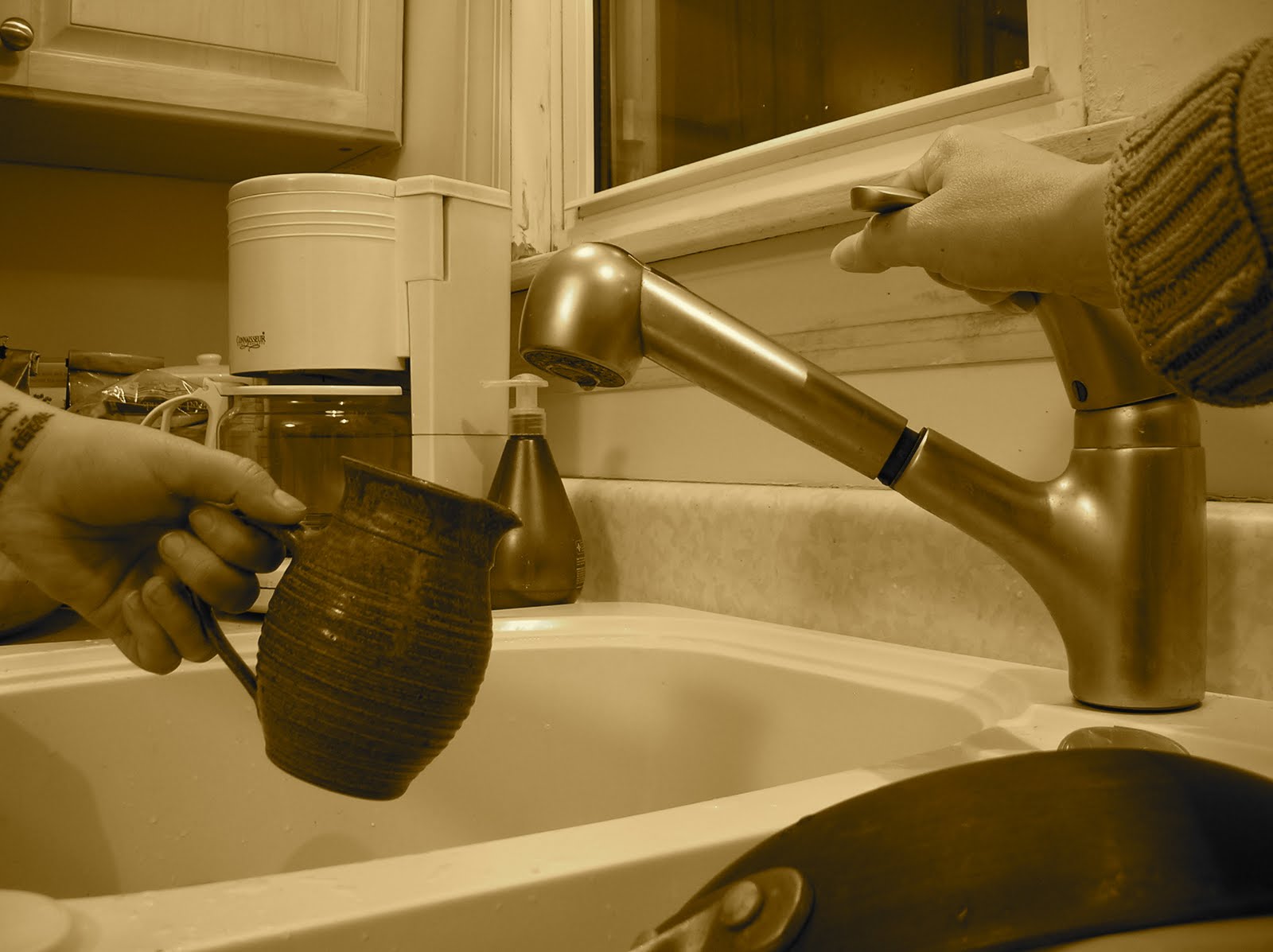
One last photo of Lazarus...

I've been stumbling along with those in the story this week. Thomas who was sure he was heading towards his death. Martha, who gives us this amazing confession of faith in Jesus as the Messiah, but still doubts that he will actually raise Lazarus. Mary, who simply pours out her grief in weeping and wailing at Jesus feet. And as I've finally come to the end of the story, I've come to realize that it is those who stumbled along who experienced God's love. Jesus weeping with them. It is those who stumbled along who witnessed God's power. Jesus raising Lazarus from the dead. It is those who stumbled along who came to believe more fully that Jesus was the resurrection and the life.

Actually, those who were sure, those who knew what Jesus had done and felt they knew who Jesus was, the religious leaders... those were the ones that eventually condemned Jesus. Perhaps a little doubt now and then is not such a bad thing. Perhaps it leaves us open to a God who is more than anything we could ask or imagine.

Friday, April 08, 2011

A Very Human Detail


Imagine the scene. Jesus has finally arrived in Bethany. He is late, of course, and Mary and Martha have both confronted him about it. Lazarus is already dead. The people are wailing in grief. Jesus himself is angry and crying. But there is a sense that something is about to happen. Something he said to his disciples about Lazarus just being asleep. A promise he made to Martha that Lazarus will rise again. Jesus walks up to the tomb, raises his arms and commands, "Take away the stone!" But before anyone can react... Martha steps in.

"Um... Lord... do you really want to do that? It is going to smell really bad."

As I've reflect on Martha's words in this moment, I have been struck by two things. First, how very like Martha I am. God can be in the midst of doing miraculous things. The drama can be building. Everyone else is caught up in the moment. And I'll be worried about some very human detail. How will we feed all these people? What are we going to do with all these fish? Um, Jesus, the boat is sinking. There's a storm on the horizon. She shouldn't be doing that, should she?

It seems that whenever the disciples had those very human moments, those moments when they couldn't quite see beyond the very earthly existence of this world, Jesus just seemed to shake his head and patiently continue with his miracle. He seems to know that at times we will be people of little faith. He seems to know that what he is promising really is beyond anything we could ask or imagine. All he seems to ask for is the faith that we do have. The willingness to keep moving forward with Jesus with what we do know. And if we continue to walk with him, he will reveal his glory.

Second, how grateful I am that our Bible is full of these little human moments. That it is not some perfectly scripted drama, but rather a very human endeavor. It is these little human moments that allow me to enter into this story not as a fantasy to escape this world but rather as God's plan of redemption for this world... this world with all its tastes and sounds and sights and even smells.

As we draw closer to the cross, closer to our Easter celebration, may we be willing to lay at Jesus feet our all too real little bits of faith and may we enter into this story, this plan of redemption for the world.

Thursday, April 07, 2011

I Am the Resurrection and the Life


In the Mary and Martha story of Luke 10, I have always identified more with Martha. She was the good girl, the sensible one, the one with all the right answers... I am guessing she was the older sister of the two. (I am making no judgments here on one being better than the other! Just identifying...) And when we meet up with her again in John 11:21ff, we see that not much has changed. She goes out to greet Jesus and while she begins accusing Jesus of not being there when she needed him, she immediately states her confidence in his ability to fix this.

Or at least it seems that way. "I know that God will give you whatever you ask of him," she says. Yet when Jesus tells her that Lazarus will rise again, all she can imagine is that Lazarus will be resurrected on the last day. Jesus presses further telling her he is the resurrection and the life. She responds confessing that Jesus is the Messiah, the Son of God.

And yet, in the next scene there is no sign that Martha has convinced anyone that Lazarus will be raised from the dead. In fact, when Jesus commands people to open Lazarus' tomb, Martha can't imagine anything other than a dead decaying body lying in there. She had the right words. She even knew who Jesus was. Yet even this faith could not prepare her for the overwhelming thing that was about to happen.

I often feel that way about God's promises in my life. I hear them. I believe in them. I try to trust in them. But my own sense of what is actually being promised by God is so much smaller than what God is actually promising. Even in my best moments, I fall short of understanding the depth of God's love for me, for us, and the true abundance of life that is being offered to us. Despite my faith, I often live as if God will let me down. As if all of the promises are only for the next life.

This Lenten season, may I grow in my faith not only in the resurrection, but in the life that is promised to us here and now. Life abundant in Jesus Christ.

Wednesday, April 06, 2011

Disturbed and Moved


John 11:33-35 "When Jesus saw her weeping, and the Jews who came with her also weeping, he was greatly disturbed in spirit and deeply moved. He said, 'Where have you laid him?' They said to him, 'Lord, come and see.' Jesus began to weep.'"

Commentators generally agree that this chapter in John reveals the most divine and the most human aspects of Jesus all within a few verses. We have a Jesus with friends whom he cares for, a Jesus disturbed and moved. We also have a Jesus who knew when Lazarus had died, who proclaimed himself the resurrection and the life, and who raised a person from the dead. The extremes of the incarnation. The human and the divine. Only God could hold those together.

There is much speculation as to why Jesus was disturbed in vs. 33. It is not that there are a lack of possibilities! In fact, that is part of the problem. Was he mad at those who doubted his love for Lazarus? Or his ability to raise him from the dead? That does not strike me as very "Jesus-like," but not being divine myself I am not always right about these things. Some wonder if he was angry at those who were present but would eventually condemn him to death. Some believe he was angry at death itself and the pain it causes. Some believe that his own grief was full of conflicting emotions... anger, concern, sorrow, love... much like any other human being.

I took the image for today while it was raining out... a particularly apt moment to reflect on a God who cries with us and for us. But this particular sculpture has also caught my eye so often when driving by. I imagine it representing the anger Jesus must have felt as something crumbled. Or the crumbling of something false that happened in response to Jesus' anger. The loss of life. The loss of hope. The way that Jesus' walk towards the cross resembled a crumbling world for the disciples, but was in fact a tearing down of the old to build up something new.

Despite knowing that it was all for God's glory, despite knowing that it was the path of redemption, Jesus pauses... and weeps... reminding me that we are allowed to feel all sorts of things as we walk this path with Jesus. That sorrow and grief and anger may be appropriate emotions at times. We do not need to hide them. But we also cannot allow them to stop us from continuing to move forward... even if our destiny is with Christ's... on the cross.

Tuesday, April 05, 2011

The Meaning of Glory


As you may know from last week's posts, I tend to struggle with the idea of human suffering as a means for God to be glorified. The concept comes up again in this week's passage: ""This illness does not lead to death; rather it is for God's glory, so that the Son of God may be glorified through it." (John 11:4)

When I first read these words, I hear them through human ears. I do that far too often. It is so difficult to maintain God's perspective when reading scripture! But so important. When I first hear the word "glorified," I immediately think of someone being lifted up and praised. I think of accolades and parades and bright lights. And while that is certainly a part of what it is to be glorified, God does not need to seek such glory. God is glory. God is surrounded by God's glory. Unlike human beings, glorifying God has little do to with God's ego or need for praise. Rather, to glorify God is to recognize fully who God is...

And that type of glory did not come by way of bright lights and parades... okay, well there was a parade, a triumphal entry, but the glory came afterwards. No, not in the resurrection, though that is a part of it. We see in John 12:23 that the glory of God was present in the very suffering of Jesus, in the way of the cross. "The hour has come for the Son of Man to be glorified. Very truly, I tell you, unless a grain of wheat falls into the earth and dies, it remains a single grain; but if it dies, it bears much fruit."

The man born blind, the death of Lazarus... these were not simply so Jesus could look spectacular. They were so that people would begin to see God's power at work in Jesus. So that people would realize that Jesus was the messiah. Even if that meant, as we see at the end of John 11, such knowledge would lead to Jesus' death.

It is no easy thing to be in the path of redemption. It requires something of us. It required more of Christ than we could ever imagine. May I have the courage to seek to glorify God in a similar manner, not seeking power, fame, or even success for the sake of the gospel, but rather taking up my cross and following into Jerusalem.

Monday, April 04, 2011

Jesus... you are a little late


Our text this week moves from John 9 and the healing of the blind man to John 11 and the death and raising up of Lazarus. The story does not start off very promisingly. Jesus' good friends, Mary and Martha, send a messenger to let him know that their brother, Lazarus, is very sick. They clearly want him to come quickly, but he doesn't. Instead, he stays where he is for two days before answering their note and and by the time he makes it to their house in Bethany... Lazarus is dead. According to Jesus, this is all so that God might be glorified... much like the man in John 9 was born blind so that God might be glorified.

I am having one of those seasons in my life where I feel a bit like Mary and Martha. I seem to be sending Jesus messages asking him to head my way. There is an urgent need that requires his presence. But Jesus seems to be delaying in response, too busy elsewhere, has other things on his mind... or perhaps even intends my suffering during this delay to be for God's glory. But at the moment, I don't really understand it at all. And I doubt Mary and Martha did either.

In this midst of this terrible scene... Jesus, himself, failing to respond to a dear friends illness... there is one verse that gives me pause and causes me to hope. Verse 5 says, "Accordingly, though Jesus loved Martha and her sister and Lazarus..."

What does this tell me? It reminds me that when Jesus seems to be silent, when Jesus does not seem to come when I need him, when Jesus delays answering my prayer or bringing the healing I seek, it is not because Jesus does not love me. Jesus does love us, even when he seems absent. I don't always understand what that love means in the moment. But I do know that Jesus' love was deep enough to drive him to the cross and sacrifice his life on our behalf.

We don't always understand Jesus' actions, but like Mary and Martha, we are to trust in Jesus' love.

Saturday, April 02, 2011

Spiritual Blindness or Blind Faith?


John 9:40 "Some of the Pharisees near him hear this and said to him, 'Surely we are not blind, are we?'"

For the last few days I've been mulling over the idea of spiritual blindness present in our text for this week. Our preacher for Sunday, Melanie, commented on it as she shared themes for her sermon and my friend Cathy wrote her Lenten blog on the topic yesterday. Their thoughts have caused me to ponder my own feelings of spiritual blindness these days... actually they are feelings of spiritual blindness that I have been having for a few decades now, ever since the unshakable faith of my conversion was shattered by one too many unanswered prayers and a disillusionment that comes with the realization that the church is far from perfect.

It feels sometimes as if I can't see Jesus for all the pain and suffering in the world... not just in my own life, but now that my eyes have been opened to the depth of racism and sexism in the world, now that I am grappling with global poverty and my inherent role in it, now that I realize that God's blessing does not equal money, relationships and security... it feels at times that it is harder to see Jesus. That faith I had when I was a new Christian that everything would work out in the end, that it would all turn out just right, is gone and it feels at times as if my faith in Jesus is a bit tenuous because of it.

It feels like spiritual blindness, but I wonder now if before I was actually acting on blind faith. I wonder if before I had faith but I failed to see the world as God sees it. I wonder if my eyes were really closed to all the things that God cares about, the poor and the weak, the least and the lost, those suffering from injustice. Perhaps what I am experiencing is not spiritual blindness, but rather learning to see through God's glasses. My eyes and my heart are still adjusting a bit... because of course seeing with God's eyes is not easy for us mere human beings. And yet is what God desires of us, what God gifts us with... to see the world as God sees it that we might understand more of this God that we love and follow.

Friday, April 01, 2011

Am I Willing to Be Put Out?


John 9:22 "His parents said this because they were afraid of the Jews; for the Jews had already agreed that anyone who confessed Jesus to be the Messiah would be put out of the synagogue."

Over the last few years I have been regularly faced with having to consider what it might mean to leave the church. This is not a commentary on my own denomination or what they believe. All denominations have strengths and weaknesses. I happen to think my denomination has more strengths than many others... but still, if you are going to enter into serious theological reflection, especially in a PhD program (yes, I recently finished my PhD), but also in a living dynamic relationship with God, the Bible, and the world, you must be willing to entertain this thought. What if, through prayer and reflection, through the reading of scripture, theology and church tradition, I come to a disagreement with my church... a fundamental disagreement that, should I clearly voice what I have come to believe may threaten my place within the denomination?

Perhaps you think this is not possible. That the church and tradition are always right. Well I am pretty certain that the blind man's parents in this passage felt the same way. I don't doubt they had tremendous trust and faith in the synagogue... but they were coming to a new understanding, one that put them at odds with the very community that had led them to God in the first place.

What do you do? Now I realize there are some who would easily walk away, find a new church, a new denomination, a new religion. I actually don't think it should be that easy. I think that such decisions to change communities of faith should only come after deep soul searching, in community with others, after much prayer. Without a commitment to one another, there is no community to leave in the first place.

But, what do I do when I feel compelled to witness to something that might get me "put out of the church?" Will I be willing to take the risk? Will I be willing to give up the security? And in my case, would I be willing to give up a potential career?

I am not considering any of these things at the moment, but I think they are important to reflect on. I think we must recognize the choices we have made to be a part of the churches and denominations we are part of. We chose to be here. We can chose to leave. Will we risk when we feel God is showing us something, challenging us in some way? Or will we remain silent like the parents in the passage for today?

Thursday, March 31, 2011

Losing God in the Sabbath


John 9:16 "Some of the Pharisees said, 'This man is not from God for he does not observe the sabbath.' But others said, 'How can a man who is a sinner perform such signs?' And they were divided."

In the Jewish tradition, families mark the sabbath by lighting a candle 18 minutes before sundown on Friday. For the next day, until three stars appear in the sky on Saturday evening, no work is to be done. It is a day of "ceasing" from the Hebrew "shabbat" which we translate as Sabbath. It is a day of rest marking the seventh day of creation when God rested. It is a day to celebrate release from slavery and an enforced seven day work week.

But it seems that over time Sabbath became a marker for those who were from God and those who were not. Those who kept it properly, observed all the right rules, were strict and rigid in their discipline were considered faithful. Jesus, of course, broke the Sabbath rules regularly by healing on the Sabbath and allowing his disciples to gather grain to eat.

I am not so much concerned about judging the Pharisees in this passage for their condemnation of Jesus for healing on the Sabbath. Rather, I am wondering about what my rules are? What are those things that I consider as sacred as the Sabbath? Those things that I believe can help me to distinguish someone who is from God and someone who is not? What are those practices that have become more important than faith itself? More important that loving God and loving my neighbor as myself? More important than doing justice, loving mercy, and walking humbly with my God?

I am not saying that our faith shouldn't show in our actions. And I am definitely not saying that some historical practices of the church aren't important disciplines in our life... but when do I cross that line where the discipline comes define me rather than the God who established it? When do I become about purity but not holiness? When do I become about individuals rights and not justice? When do I read the Bible but fail to see God? Attend church every Sunday but forget to worship?

Wednesday, March 30, 2011

Exactly When Was He Healed?


After Jesus spreads mud on the blind mans eyes, he tells him to go wash in the pool of Siloam (John 9:7) No one knows exactly when the man was healed. Was it the moment Jesus' touched him applying the mud to his eyes? Was it the washing in the pool of Siloam? Did it happen as the blind man was walking back to Jesus after washing?

In reflecting on this part of the text, I have been thinking a lot about Baptism... as evidence by the picture of my churches portable (well, supposedly) baptismal pool. There are many theological positions on what happens at Baptism. Is it simply an outward human act symbolizing what God has already done for us and in our individual lives? Does it have any salvific powers at all? Does God do something special during baptism? Is the Holy Spirit present in some unique way?

I don't actually have a good answer to any of those questions... except to say this... it is something that God commanded and so I have to believe that something significant happens in the act. I don't know exactly when a person gets saved. Is it the moment they are touched by Jesus? Is it during baptism? Is it when they walk into their faith after baptism? Is it the act of obedience in responding to Jesus' command to "go" in the first place?

Perhaps its does not actually matter. I don't think the blind man cared when exactly he was healed. All that mattered to him was that he was healed and Jesus was the one who healed him. And it isn't even the act of healing that is significant. It is the fact that now he can see!

Perhaps more important than the exact moment we were saved is the fact that we were saved. That Christ offered salvation to us in a muddy mix of his body and blood. That once touched by the mud of the cross, we are washed clean from our sin. And now that we have been cleansed, we are righteous... called to live not as those who walk in the dark, but as those who can see.

Healing Touch


Sorry, I forgot to post yesterday! It is not that I wasn't thinking about it... I just forgot to take the photo and get it up on the blog.

John 9:5-6 "'As long as I am in the world, I am the light of the world.' When he had said this, he spat on the ground and made mud with the saliva and spread the mud on the man's eyes."

"I am the light of the world." Such a grand statement from Jesus. A beautiful, dignified image of who he is. And then he turns around and spits. Not only that, he reaches down and mixes his spit with the dirt on the ground and then scoops some up and spreads it on a poor blind man's eyes! So unsanitary! So not what I expected from the light of the world! Though perhaps it connects a bit with the living water from last week's passage on the woman at the well?

I'm not sure why spit had to be involved, but I appreciate the healing touch involved. I don't see or experience enough of that these days. There are so few places where people can express affection, care or concern for another person with physical touch as an adult outside the immediate family. There are healing touches by Doctor's, but so often they are supposed to remain distant and scientific to keep from giving off the wrong impression. Pastor's often hold hands with someone or place a hand on their shoulder when praying, but they have to be very careful about lingering too long or crossing boundaries. Adults have to be so careful about touching other people's children... and some need to be careful about how they touch their own. I am not saying that we shouldn't be careful about this issue. And I mourn with those who may never experience physical touch in a positive way because of their experiences of sexual abuse or violence.

I do think, though, that we have lost something in our society. I think somehow touch has become almost exclusively equated with sex and violence in our society. We have lost the sense of touch as healing and intimacy. Not completely. But close to it... I think we could learn from our brothers and sisters around the world who express friendship a bit differently. Men who hug and women who hold hands. Those who greet each other with a kiss on the cheek. I think there can be something healing in healthy appropriate physical touch from another person. I know I have appreciated attending a church where hugs are a normal part of the morning service. Perhaps there is something about a healing touch that allows us to also be a bit of the light of the world.

Monday, March 28, 2011

Night and Day


Our text for this week is the healing of a man born blind and the ensuing controversy among with the Pharisees that follows in John 9. The text begins with the disciples asking whose sin caused this man to be born blind. Jesus responds, "Neither this man nor his parents sinned; he was born blind so that God's works might be revealed in him. We must work the works of the one who sent me while it is day; night is coming when no one can work."

Now to be honest, it is not an easy thing for me to think of God allowing someone to be born blind so that God's works might be revealed. But perhaps that is a question for another day. And perhaps it speaks more to my own fears of blindness than to anything else.

My picture for today was intended to reflect the idea of having to work "while it is day." As I am reflecting on that phrase, I find myself quite resistant to what it might mean. It suggests an urgency to God's mission. It suggests an end point, a night fall, a period when the mission is no longer possible... I don't really like to think about that. I prefer to think that I have all the time in the world to get things right, to straighten things out, to say the things that need to be said. But that just isn't true, is it? There are end points in life. People die. People grow old and opportunities begin to fade away. People run out of time for health or child birth or healing of relationships or careers and callings.

I say all this not to be pessimistic, though that is at times in my nature, but to help myself come to grips with the limits in my life. They are not a bad thing. Just a part of being human. And they should push us to live each day with a bit more intentionality, to make choices that reflect our priorities and values, to stop putting off for today what may not be possible tomorrow. What are the works that I am called to do while it is day? What have I been sent for?

Saturday, March 26, 2011

Jesus... that's close enough


I don't know if you have ever been at a point in your life when God seems to be drawing closer... not in a good "I feel the warmth of God's presence" kind of way... not a comfort in grief or a growing sense of your relationship with God. But God wanting to step across another internal boundary in your life. God wanting to help you grow and deepen and become more whole and human. But in order to do so, you have to let God in even deeper, perhaps to places you have kept sealed up for a long time, perhaps to places you didn't realize even existed.

I feel like I am nearing one of those moments... and it feels a bit like I imagine the woman at the well felt when Jesus said to her, "Go and get your husband..." Of course for the woman at the well it was a complete stranger suddenly delving into her personal life. Who then proceeds to dive in even deeper as he reveals that she has had five husbands and is currently living with another man. I imagine that could not have been very comfortable for her. Though she may be much more secure than I am.

I know that I need to push forward... or, perhaps more accurately, allow God to keep pushing forward. I know that God welcomes my questioning. At least Jesus seemed to welcome the woman at the well's numerous questions throughout the encounter. I know that God moves slowly, often revealing only the truth we can handle at the moment and waiting for us to begin to grasp the deeper truth. Mostly I know what is waiting on the other side. That spring of living water that is promised. That gift that allows you to never be thirsty again. The spring welling up to eternal life. The presence of the Holy Spirit. My God grant me the courage, this Lenten season, to continue to remain open as God moves deeper into my life.

Friday, March 25, 2011

Are Boundaries Good or Bad?


Wow... I started writing a short post on the boundary crossings that take place in the story of the woman at the well and a few pages later still hadn't gotten anywhere. There is so much to say about boundary crossings and they are so tricky! So often boundaries are crossed in ways that do violence to another person. So often boundaries are set up to exclude or demean others... or to make ourselves feel better about ourselves. So often we pretend to cross boundaries for the good of another person (or people group or nation), when we are actually doing it to meet some need of our own. And of course, there are those people who have no boundaries, who have lost any sense of self and have become enmeshed with everyone around them.

I'm not sure this text helps us to sort through our boundary issues. Jesus seems to cross all sorts of boundaries regarding race, gender, and religion with the woman at the well. The woman seems to cross several boundaries herself, responding to Jesus' questions with her own questions and leading him into a deep theological discussion. A discussion which she then shares with the rest of her community. There are times when boundary crossing can be deeply healing and meaningful. Boundary crossing can be a way not of demeaning or overpowering another, but of recognizing the worth and humanity of another.

But my own challenge for this week? I have very high boundaries in my life... mostly for very good reasons. It has served me well in my role as a pastor and former dean of students. It has not served me quite as well in my personal life. How do I find a way to allow my boundaries to more fully reflect the community that God has called me to? How do I find a way to shift my boundaries a bit so they remain strong but also healthy and permeable when needed?

Thursday, March 24, 2011

Why Do I Still Thirst?


So, the picture for today isn't that great. As I was taking it, the battery on my camera died. And, of course, the spare batteries are currently being used elsewhere. Oh, and the battery on my computer is dying. And, if I could find my cell phone, which at the moment I cannot, I'm sure that battery would be dying to. And I am feeling quite depleted today. Spent 2 1/2 days doing some vocational discernment. I feel a bit dried up and worn out.

But to the passage for today... John 4:14, "but whoever drinks of the water that I shall give shall never thirst, but the water that I give shall become in them a well of water springing up into eternal life."

Um... God? Did I miss something? Am I not supposed to be feeling this way? Am I always supposed to be filled to the brim emotionally and spiritually? But why does my spiritual life feel like a pitcher of water that constantly needs to be refilled? Why do I sometimes wonder if my spiritual well is cracked and leaking?

I'm not sure I have any good answers. I wonder if perhaps the goal is not to be filled all the time, but simply to be something the living water can flow through. We are not to be a well that fills up spiritually and then becomes stagnant. We are to be fountain that allows the living water of the Holy Spirit to spring up and overflow.

Though, perhaps even more to the point... maybe I am thirsty because I keep asking for the wrong water. Maybe I keep dipping into Jacob's well instead of turning to the one who created the water in the first place.

Wednesday, March 23, 2011

Where Should I Worship?


The Samaritan woman at the well, after hearing Jesus tell her everything about herself, decides that Jesus is a prophet. And if he is a prophet, he must be sent by God. So, she wants to know where she should go to worship God. The Jews and the Samaritans disagreed about this. The Samaritans thought there was a holy mountain. The Jews argued that one must worship in Jerusalem. Jesus had other plans. With the coming of Christ, everything would change. The God who had chosen to dwell in the tabernacle and the temple, the God whose presence was in the Holy of Holies, would break forth in Spirit and be worshiped everywhere.

I wonder if at times we have come to associate God too much with a particular place. I wonder if church has for many of us become a holy mountain or a Jerusalem. I wonder if we think we must go somewhere to meet God. Sometimes I wonder if we wouldn't all be better off if the pews were empty a little more often as we recognized God's presence everywhere.

On the other hand, I also wonder if sometimes we go to places where God is present without ever truly seeking God. The Samaritan woman's questions were the stirrings of someone who had recognized God at work and wanted to respond in worship. When I see God work, how to I respond? Does it drive me to worship? Not necessarily to a place, but at least to a posture?

Tuesday, March 22, 2011

Sharing A Cup


"Give me a drink," Jesus says to the Samaritan woman. A simple request. He is sitting by a well, thirsty from his travels, water just a few feet away, but no bucket to get at it. It feels a bit like we are back in the wilderness with Satan tempting Jesus to turn these rocks into stone. But know, Jesus chooses to ask someone for help... a Samaritan no less, someone who would make him unclean... and a woman... two strikes... oh, and living with a man who is not her husband! Jesus really can pick 'em, can't he?

I find it fascinating that Jesus' first words of witness to this woman are not about the living water he provides or about her sinfulness or about the right place to worship... he gets to all of that eventually... rather his first words are a request. A request that makes Jesus vulnerable to this woman, to her "uncleanliness" (in the Biblical sense, of course!) and leaves him indebted to her.

What can this passage teach us about evangelism? What might it mean to approach others not with something to offer, but showing our need? What might it mean to approach the world with a realization that we must rely upon one another? That each person has something valuable to contribute? What might it mean to have acts of service and mercy not be about reaching down to others? But reaching across to them? And being willing to share a cup with them?

What if evangelism begins not with an answer, but with a question?

Monday, March 21, 2011

Put Your Erasers Down


I had this great idea... take a picture of one of my journal entries to represent Jesus speaking to the Samaritan woman at the well and telling her everything that she ever did (John 4:39), because Jesus already knows all that is written in them.

Well, I looked at the first pictures and realized that I better start erasing some of the words to protect the innocent (well, at least my innocence!). Eventually, though, I was erasing whole lines and then whole paragraphs! I had to spend several minutes going through my journals to find a few pages that I would be willing to reveal.. well, for the most part.

I was struck through this process by the incredible vulnerability that the woman must have felt. Jesus looking into her soul and naming the one thing she was perhaps most ashamed of. Amazingly, she does not respond with shame or fear or anger. Instead, she recognizes Jesus as a prophet and asks where she should worship God. I have a lot to learn from this woman. That standing open and vulnerable before God is not something to fear or avoid... but rather when we allow Jesus to peer into the corners of our heart and mind, when Jesus tells us who we... those are the moments when we see most clearly who our God is, our omniscient, holy, and grace-filled God.

Saturday, March 19, 2011

To Much Information?


I know it is a bit early in the Lenten season for the cross... but I can't stop thinking about the fact that Peter, James, and John, when they looked at all Jesus was going through before the crucifixion, and then to see Jesus on the cross (at least I think they saw him there)... of all the disciples, of all those who witnessed what was happening, they had been the ones just days or weeks before to see how glorious Jesus truly was. They must have known, perhaps in a deeper way than the others, that God's son had just been killed. And Peter... with that knowledge, with that glorious image of Christ on the mountaintop at the crucifixion in his head. Can you imagine the weight of guilt when he denied him three times?

Would it have been better if they had never known? If Christ had waited to reveal himself until the resurrection? Looking back, would they have wished the transfiguration never happened?

There are times in my life when I wish I didn't know God so well. Times when in my doubts and struggles with God, in my anger and frustration with the world around me, I think how much easier it would be to walk away. There are days when my faith seems to difficult to bear, when the weight of racism and sexism and all of those other oppressions that have woven themselves into the fabric of the church is overwhelming and I wish I could walk away.

Most of the time, however, I am thankful for the glimpses of God that I have received. I am grateful that the Holy Spirit enable faith and this connection with God that is beyond understanding. And I rejoice that even in my darkest days, I can't seem to let go. I think that is what transfiguration moments are all about. They are glimpses of God's glory that get us through the tough times. For although Peter, James and John knew that God's son was being crucified, they also knew that he existed and had walked with them and talked with them. And perhaps the transfiguration was what enabled them to get through it. To have that slim thread of hope that caused them to run to the tomb when Mary told them the body was missing.

Friday, March 18, 2011

If we only knew...


Up in the corner of one of my closets sits an old silver goblet. Well, age is all relative. It is as old as I am. It is tarnished. It is unused. It is about the only antique I have. One glance at it and you would probably pass it over. But hidden on the back is an engraving of my name. It was a gift to my parents when I was born (I think...)

Jesus was not so old, but he may have looked at bit run down and tarnished after three years of intense ministry, walking from city to city, managing a group of unruly disciples, being pursued by crowds seeking healings and miracles. What he did was quite fantastic, but if you hadn't heard the stories or seen the miracles, he probably looked just like any other guy. Quite unremarkable.

But then, on this one day, he takes a few friends up to the top of a mountain and gives them a little peek. Underneath all that humanity was the glory of God shining through (all right... not the most accurate theological language for the incarnation, but you get the point) I wonder if people would have treated Jesus any differently had they known? I wonder, if I came face to face with God's glory for a moment, if it would change how I treat God? Do I treat God like an old family heirloom or antique that I leave hidden up in a closet? Or do I cherish God knowing God's full worth?